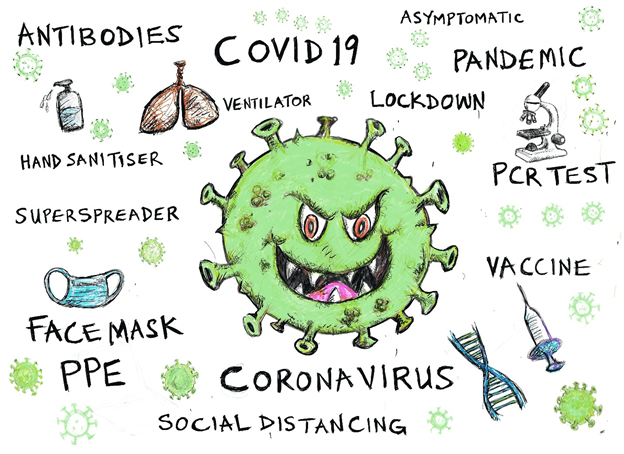
The Covid-19 Pandemic has brought with it a whole new bunch of terms and coinages that were previously unknown and unused by the man on the street. Today we hear terms[1] that are commonly spoken on the news by newscasters and correspondents covering covid related news and at press briefings by Governors and Scientists. Even my nieces and nephews have incorporated the Covid-19 lexicon into their everyday vocabulary.[2]
But what do they all mean? In this article I try to identify and explain the popular and common covid terms as best I can, using Centres for Disease Control and Prevention (CDC), the World Health Organization (WHO), Yale Medicine Doctors, Nursing Center Blog and other health and medical sources. It is hoped that a clear understanding of the terms would also promote the need to stay safe and prevent the spread of the virus.
Aerosol: suspension of tiny particles or droplets in the air, such as dust, mist, or fumes. These particles may be inhaled or absorbed by the skin and can sometimes cause adverse health effects for workers.
Aerosolized virus particles: Smaller than droplets, these particles can be expelled by an infected individual. They hang in the air longer than larger droplets, which tend to fall due to gravity.
Airborne transmission: the spread of an infectious agent caused by the dissemination of aerosols that remain infectious when suspended in air over long distances (greater than one meter) and time. Some medical procedures can produce aerosolized droplets, and if performed on COVID-19 patients, the aerosols may contain the SARS-CoV-2 virus and could be inhaled by other individuals.
Antibodies: molecules produced by the immune system to fight infection. People who have recovered from COVID-19 develop antibodies to the virus which could be used to help treat others who are infected and help researchers develop vaccines to prevent infection. At this time, researchers do not know if the presence of antibodies indicates an individual is immune to SARS-CoV-2 in the future, or how long immunity might last.
Antibody test: detects the presence of antibodies to a specific pathogen and indicates whether an individual had a previous infection. This test will not indicate if an individual has a current infection and should not be used to diagnose COVID-19.
Antigen test: detects the presence of viral proteins; typically used in acute or early infection as the antigen is detected when the virus is actively replicating. This diagnostic test should indicate if an individual has a current infection.
Asymptomatic: not exhibiting signs or symptoms of illness. In an asymptomatic individual, the SARS-CoV-2 virus RNA may be detectable, but symptoms don’t develop. Researchers have found evidence that supports asymptomatic transmission of COVID-19.
Comorbidity: A medical condition that increases a person’s risk of becoming very sick if they develop COVID-19. These conditions include chronic kidney disease, COPD (chronic obstructive pulmonary disease), obesity, serious heart conditions and type 2 diabetes. Other conditions that may up someone’s risk of severe COVID-19 disease include asthma,
hypertension, compromised immune systems, smoking and type 1 diabetes.
Contact tracing: or contact investigation, is a public health approach used to contain the spread of pathogens. The goal of contact tracing is to identify, treat, and isolate current and potential cases of an infectious disease in order to control and prevent further human-to-human transmission. For the novel coronavirus, the CDC defines a close contact as somebody who has spent at least 15 minutes within 6 feet of a person with a confirmed or probable case of the coronavirus.
Convalescent plasma: plasma donated by individuals who have fully recovered from a disease and whose blood contains antibodies to that disease. This plasma may be administered to hospitalized patients currently fighting the disease and may help them recover.
Coronavirus: a group of viruses named for the crown-like spikes —coronas—that appear on the viruses under a microscope on their surface. Coronaviruses can cause the common cold (which can also be caused by other viruses, such as rhinoviruses), as well as dangerous illnesses such as severe acute respiratory syndrome (SARS) and Middle East respiratory syndrome (MERS)There are four main sub-groupings of human coronaviruses, known as alpha, beta, gamma, and delta that are responsible for mild upper respiratory tract illnesses. Three additional sub-groups are associated with increased morbidity and mortality: Middle East Respiratory Syndrome coronavirus (MERS-CoV), severe acute respiratory syndrome coronavirus (SARS-CoV) and the novel severe acute respiratory syndrome coronavirus 2 (SARS-CoV-2) that causes COVID-19.
COVID-19: coronavirus disease 2019, formerly referred to as “2019 novel coronavirus” or “2019-nCoV”, is caused by the SARS-CoV-2 (first discovered in December 2019) and spreads from person to person through respiratory droplets. COVID-19 illness can range from mild to severe with symptoms such as fever, chills, cough, shortness of breath, fatigue, muscle/body aches, headache, loss of taste or smell, sore throat, congestion, runny nose, nausea, vomiting, or diarrhea. Severe illness can lead to hospitalization, ARDS, and increased morbidity and mortality.
Cytokine Storm: an acute systemic inflammatory syndrome, or an excessive immune response, characterized by fever and multiple organ dysfunction (Porter & Maloney, 2019) that often develops after a severe viral infection. Some COVID-19 patients may experience a cytokine storm which could explain the development of critical illness in some and not in others.
Diagnostic COVID-19 test: indicates whether an individual has a current, active infection. There are two types of diagnostic tests available for COVID-19: molecular tests detect the presence of viral genetic material and antigen tests detect the presence of viral proteins.
Droplet transmission: respiratory infections can be transmitted through droplets of different sizes. If the droplet particles are greater than five-ten micrometers in diameter, they are referred to as respiratory droplets. If the particles are less than five micrometers in diameter, they are referred to as droplet nuclei. Based on current evidence, COVID-19 virus is primarily transmitted between people through respiratory droplets and contact routes.
Emergency use authorization (EUA): allows the FDA to respond to public health threats such as chemical, biological, radiological and nuclear (CBRN) agents by facilitating the availability and use of medical countermeasures (MCMs) needed during public health emergencies. Section 564 of the Federal Food, Drug, and Cosmetic Act permits the FDA to allow unapproved medical products to be used in an emergency to diagnose, treat, or prevent serious or life-threatening diseases caused by CBRN agents when there are no available alternatives. The following products have EUA authorization for COVID-19: In Vitro diagnostic products, molecular-based laboratory tests, SARS-CoV-2 antibody tests, personal protective equipment, ventilators, drug and biological products.
Endemic: the amount of a particular disease that is usually present in a community, the baseline, expected or observed level of the disease. It is the constant presence or usual prevalence of a disease or infectious agent in a population within a geographic area .
Epidemic: refers to an increase, often sudden, in the number of cases of a disease above what is normally expected in that population in that area.
Epidemiology: the study of the distribution and determinants (causes) of health-related states or events in specified populations, and the application of this study to the control of health problems.
False positive result: a test indicating a positive result, but disease is not present in the individual.
False negative result: a test indicating a negative result, but disease is present in the individual.
Flattening the curve: utilizing a combination of strategies to slow the spread of a disease (i.e. COVID-19) which would spread out the peak of the epidemic and prevent hospital capacity from being overrun.
Fomite: An object covered with virus particles, possibly because someone recently sneezed or coughed respiratory droplets onto it. A countertop, a phone or article of clothing could become fomites if contaminated — and serve as a potential source for “indirect” transmission if a person touches the virus-covered surface and then introduces the virus to their eyes, nose or mouth. The Centers for Disease Control and Prevention describes this as a “possible” route of coronavirus transmission but maintains that close contact between people is thought to be responsible for most new infections.
Hand hygiene: refers to the act of cleansing or sanitizing your hands in an effort to keep you healthy and prevent the spread of infections from one person to another. Washing your hands for at least 20 seconds or utilizing an alcohol-based hand sanitizer are both effective forms of hand hygiene. Germs can spread from other people or surfaces when you touch your eyes, nose, and mouth with unwashed hands; prepare or eat food and drinks with unwashed hands; touch a contaminated surface or objects; blow your nose, cough, or sneeze into hands and then touch other people’s hands or common objects.
Herd Immunia threshold proportion of immune individuals that should lead to a decline in incidence of infection, or a pattern of immunity that should protect a population from invasion of a new infection.
Immunity: is achieved through the presence of antibodies to that disease in a person’s system. There are two types of immunity:
- Active immunity results when exposure to a disease triggers the immune system to produce antibodies to that disease. This occurs either through natural immunity or vaccine-induced immunity.
- Passive immunity occurs when a person is given antibodies to a disease rather than producing them through their own immune system (e.g., a new-born receives immunity from the mother).
Infection control: prevents or stops the spread of infections in healthcare settings. There are two tiers: standard precautions for all patient care and transmission-based precautions used for patients with known or suspected infections, including contact precautions, droplet precautions, and airborne precautions.
Incubation period: as it relates to disease, is the time from exposure to a disease and the onset of initial symptoms. The incubation period for COVID-19 is between 2 and 14 days, with a median time of 4-5 days from exposure to symptom onset.
Isolation: separation of a person or group of people known or reasonably believed to be infected with a communicable disease and potentially infectious from those who are not infected.
Long-hauler: a term used to describe individuals who contracted COVID-19 but whose symptoms linger for weeks or months as opposed to the typical 14 days. Recovery is tentative, variable, and not guaranteed.
N95 respirator: Sometimes casually referred to as an “N95 mask,” this PPE is worn on providers’ faces, forming a tight seal around the nose and mouth. Though it looks like a surgical mask, an N95 is actually a respirator that filters out at least 95% of particles in the air. What’s more, it requires a 20-minute “fit test” to ensure proper fitting—and it does not provide adequate protection for people with facial hair. The CDC does not recommend N95 respirators for public use.
Outbreak: similar to an epidemic; an increase, often sudden, in the number of cases of a disease above what is normally expected, but within a more limited geographic area.
Pandemic: an epidemic that has spread over several countries or continents, usually affecting a large number of people.
Personal protective equipment (PPE): refers to protective clothing, helmets, gloves, face shields, goggles, facemasks and/or respirators or other equipment designed to protect the wearer from injury or the spread of infection or illness. PPE used by healthcare providers caring for COVID-19 patients includes surgical masks, N95 respirators, medical gloves and gowns.
Physical distancing: with respect to COVID-19 refers to maintaining at least 6 feet of physical space from others to decrease the spread of SARS-CoV-2.
Pre-symptomatic: the phase in which viral genetic material (i.e., SARS-CoV-2 RNA) is detectable prior to the onset of symptoms. Researchers have found evidence that supports pre-symptomatic transmission of COVID-19.
Quarantine: separation of people who are not yet symptomatic but have been exposed to a contagious person and are believed to be at risk of developing an infection. During the Ebola outbreak, for example, it was 21 days. For COVID-19, the recommended period is 14 days.
Rapid diagnostic test (rapid antigen test): immunoassay that detects the presence of a specific viral antigen, indicating a current viral infection. Rapid tests are often used to diagnose respiratory pathogens such as influenza. The FDA has granted EUA for antigen tests that can be used at point-of-care to identify SARS-CoV-2 in approximately 15 minutes. These tests are performed on nasopharyngeal or nasal swab specimens and results are more accurate when individuals are tested in the early stages of infection, when viral load is highest.
Reproductive Rate (R0): “R zero” or “R naught” refers to the average number of people that an individual with a virus can infect in a completely susceptible population. Scientists believe the R0 for COVID-19 falls between two and three; in other words, one person can infect two to three people.
Reverse transcription polymerase chain reaction test (RT-PCR): molecular test used to detect the presence of genetic material of a virus. COVID-19 RT-PCR tests are performed on nasopharyngeal swabs, oropharyngeal swabs, blood or stool samples. This diagnostic test is relatively accurate, but results take time.
SARS-CoV-2: severe acute respiratory syndrome coronavirus 2, a highly infectious pathogen that causes coronavirus disease 2019, or COVID-19.
Second wave: A fresh crop of coronavirus infections in an area where public health officials had brought virus transmission down to low levels. For instance, Hokkaido, Japan experienced double-digit increases in case numbers in April after reopening schools and allowing public gatherings. U.S. health officials have warned of a possible second wave of infections in the fall even as the country continues to battle its first wave.
Self-monitoring: This simply means checking yourself for COVID-19 symptoms, including fever, cough, or difficulty breathing. If you notice symptoms, you should self-isolate and seek advice by telephone from a health care provider or local health department to determine whether you need a medical evaluation.
Sensitivity: with respect to testing, is the probability that an individual with the disease will test positive. A test that has high sensitivity will produce fewer false negative results.
Shelter-in-place: an official order, issued during an emergency, that directs people to stay in the indoor place or building that they already occupy and not to leave unless absolutely necessary.
Social distancing: refers to remaining out of congregate settings, avoiding mass gatherings, and maintaining a distance of about 6 feet or 2 meters from others.
Specificity: with respect to testing, is the probability that an individual without the disease will test negative. A test that has high specificity will produce fewer false positive results.
Stay-at-home order: restricts individuals from leaving their homes for anything other than essential activities such as medical care, to shop for food, and to perform essential work. This type of order has been issued during the COVID-19 pandemic to limit the number of people exposed to the virus.
Super-spreader: an individual who is highly contagious and capable of transmitting a communicable disease to an unusually large number of uninfected individuals.
Superspreading event: When a person infected with a pathogen passes it on to an unusually high number of people. With COVID-19, large case clusters have resulted from business conferences, choir practices, funerals, family gatherings and cruises, among other settings. Virologists who researched superspreading events during the MERS outbreak say there are several possible reasons why these events emerge. Sometimes the virus may mutate to become more contagious. Or some people just exhale more virus from their lungs.
Symptomatic: showing symptoms of an illness or disease.
Transmission: How a virus gets from one individual to the next. In the case of SARS-COV-2, researchers think the virus is primarily spread via the respiratory route, through close contact with an infected person, whose virus-laden droplets are expelled from the nose or mouth and find their way into the eyes, noses and mouths of others. Other possible routes of transmission, currently under investigation, include touching virus-contaminated surfaces and then introducing those germs to one’s eyes, nose or mouth; or breathing in clouds of tiny “aerosolized” virus particles that may be traveling on air currents.
Ventilator: This is a machine to help patients breathe when their lungs are damaged, and they can’t get enough oxygen on their own. A ventilator takes over the work of breathing for a patient to allow the damaged lungs to heal; it is not itself a treatment. As there are no FDA-approved treatments yet for COVID-19, seriously ill patients are given supportive care, including supplementary oxygen and mechanical ventilatory support.
Vaccine: A vaccine triggers the immune system to help it build immunity to a disease. The immune system already has the capacity to react to diseases by producing substances called antibodies that remain in the body to fight them in the future. With a vaccine, you don’t have to get the disease to develop immunity—the vaccine triggers the same process by providing the body with a tiny amount of a germ that has been weakened or killed, but small enough that it won’t make you sick. Vaccines are introduced to the body via injection, mouth, or a nasal spray.
A Covid-19 vaccine is a vaccine intended to provide acquired immunity against Covid-19. Prior to the Covid-19 pandemic, work to develop a vaccine against the coronavirus diseases SARS and MERS had established knowledge about the structure and function of coronaviruses, which accelerated development during early 2020 of varied technology platforms for a COVID‑19 vaccine.
By mid-December 2020, 57 vaccine candidates were in clinical research, including 40 in Phase I-II trials and 17 in Phase II-III trials. In Phase III trials, several COVID-19 vaccines demonstrated efficacy as high as 95% in preventing symptomatic COVID-19 infections. National regulatory authorities have approved six vaccines for public use: two RNA vaccines (tozinameran from Pfizer-BioNTech and mRNA-1273 from Moderna), two conventional inactivated vaccines (BBIBP-CorV) from Sinopharm and CoronaVac from Sinovac), and two viral vector vaccines (Gam-COVID-Vac from the Gamaleya Research Institute and AZD1222 from the University of Oxford and AstraZeneca).
Viral load: measurement of the amount or concentration of a virus in a standard volume of blood, plasma, saliva, mucous, or other bodily fluid; usually expressed as the number of virus particles per milliliter.
Viral shedding: occurs when a virus replicates inside an organism and is released into the environment. This can happen through activities like breathing, speaking, singing, sneezing and coughing. In COVID-19, it is suspected that SARS-CoV-2 is most contagious when symptoms are worse and viral shedding is high. An early study found that COVID-19 patients shed the virus for an average of 20 days. People also appear to shed the highest amounts of virus around the time symptoms first appear.
Working Remotely: the practice of an employee working from their home or a place outside one’s usual place of business. The employee communicates with the office via email and telephone. Meetings are held via electronic business solutions like Zoom or Skype. Other tools include Microsoft Teams. Many companies have adopted this as a mode of doing business during the Covid-19 pandemic.
Zoonosis: Any disease that spreads from animals to people. The animals can range from tiny ticks to lumbering cattle. COVID-19 is considered a zoonotic disease — it is thought to have originated in Chinese horseshoe bats and spread to humans, possibly with a stop in a different animal in-between
[1] A few like, “face mask”, “social distancing” and “new normal” which I consider tautologous, misnomers and malaprops.
[2] My pre-teen nephew used the word “asymptomatic” the other day.
 DrAlexanderGrey