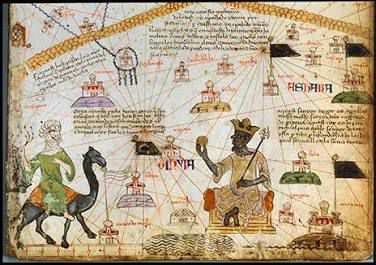
Mansa ibn Abu Bakr popularly known as Mansa Musa was the 9th Mansa of the Mali empire. He succeeded Muhammad ibn Qu in 1312. His predecessor is said to have been lost at sea while trying to find the edge of the Atlantic Ocean. Mansa Musa is often touted as one of the wealthiest men or the wealthiest man in history due to mining vast deposits of salt and gold, and trading in ivory in a vast empire which spanned much of sub-saharan Africa and part of the sahara desert. His territory included, in addition to Mali, parts of current-day Senegal, Guinea, Gambia, Niger, Chad, Nigeria, and Mauritania.
He embarked on a Hajj to Mecca in 1324-1325 and is famous for almost crashing the economy of Egypt due to his generosity and wealth. He planned his journey for almost a decade upon becoming Mansa (Ruler/King). Mansa Musa sojourned to Cairo, Mecca and Medina. His entourage comprised 60,000 soldiers and heralds, and 12,000 slaves with horses and camels each carrying about 300 pounds of gold. His heralds and servants each carried gold staffs and wore the best persian silk and fabrics of the time. His caravan must have been a spectacle to behold and hard to miss on the pristine sand dunes that defined the undulating trans-saharan caravan trail. In Egypt, he built mosques (virtually every Friday) and gave away large amounts of gold as gifts to all that encountered him. This impacted the value of gold, which was a scarce commodity in Egypt. It is said it took 12 years after the coming of Mansa Musa for the Egyptian economy to recover from his largesse. In 1375 his image adorned the Catalan Atlas which perhaps sounded the horn for a frenetic race and subsequent scramble for Africa by a Europe that was still recovering from the death and devastation of the Bubonic plague (black death) 1347-1351.
Follow and subscribe for more fun facts about history and contemporary topics.
 DrAlexanderGrey