Today, June 23 is the birthday of Alan Turing, one of the founding fathers of computing and modern artificial intelligence (AI).
Alan Mathison Turing (23 June 1912 – 7 June 1954) was a British Mathematician, logician, computer scientist, cryptanalyst, theoretical biologist and philosopher. He is famous for his Turing Test and WWII codebreaking work at Bletchley Park on the Enigma code. Turing asked the question “Can Machines Think?” in his 1950 seminal paper titled “Computing Machinery and Intelligence” and proposed the Turing Test inspired by the “imitation game” to test it. In sum Turing proposed that, “a machine could be referred to as intelligent if it could convince a human interrogator that it was human.” Turing predicted that in 50 years (that is from 1950) there would be machines sophisticated enough to play the imitation game so well that after five minutes of questioning the average human interrogator would not be able to distinguish the machine from humans 70% of the time. Turing’s prediction began to manifest in the next decade with Weizenbaum’s ELIZA a precursor of present day chatbots and companion AI. The Turing Test remains one of the popular benchmarks for assessing AI today.
We find his legacy in the CAPTCHA (Completely Automated Public Turing test to tell Computers and Humans Apart) which was designed in the early 2000s to differentiate bots from humans online. With the current advancement of AI technology, the CAPTCHA appears to be at risk of being obsolete as it has become increasingly difficult to design tests that only humans can solve.
The Turing Machine, a hypothetical computing device, proposed in 1936 introduced computer algorithms which preceded the development of general-purpose computers. Sadly, Turing’s contributions to computer science and AI were not recognized during his lifetime due to a 1952 conviction for gross indecency. Turing lost his security clearance and was unable to continue his pioneering work with the Government. He died of cyanide poisoning two years later in 1954.
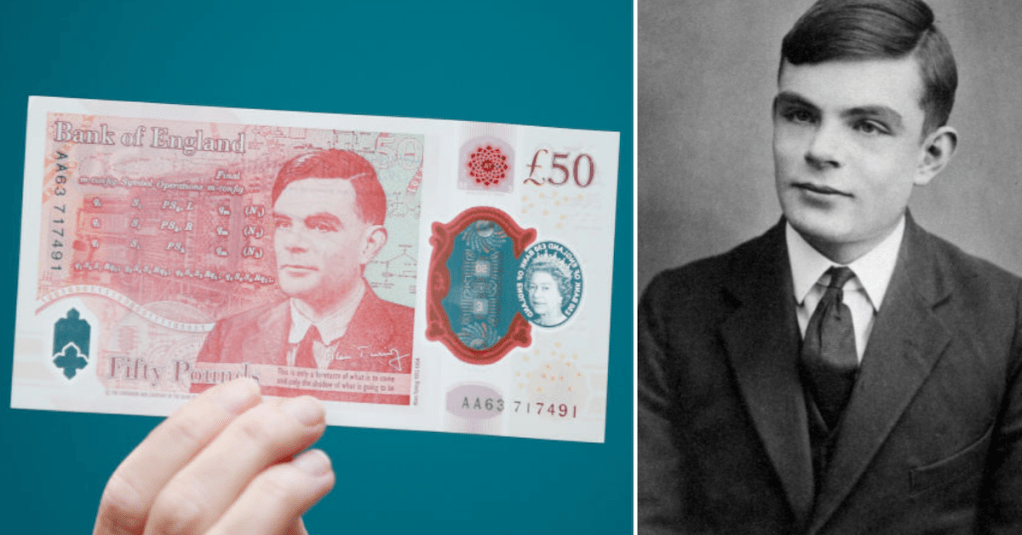
Queen Elizabeth II on 24 December 2013 granted Turing a posthumous Royal pardon expunging his 1952 conviction. In 2021, on his birthday (June 23) the new 50-pound bank note with Turing’s face went into circulation.
The Turing Award (also Known as the “Nobel Prize of Computing”) is named after him.
Turing was a brilliant mind, he stayed intellectually curious through out his life and his ground-breaking work from the 1930s to 1950s continues to inspire generations of scientists and researchers in the field of AI, Computer science and beyond.
https://lnkd.in/e5caXe5H
hashtag#AI hashtag#computerscience hashtag#history hashtag#aigovernance hashtag#dataprivacy hashtag#leadership
hashtag#capacitybuilding hashtag#knowledgeispower
 DrAlexanderGrey